← Back to the platform
Research & evidence

Follow the evidence.

The studies, methods and technical material behind PDAOAI’s research hypotheses.

Published in Biomedicines · October 23, 2026 · Open access

From a negative HCC trial to a candidate signature.

PLA compared the literature on rapalogs across separate cancer groups. Benefits in selected kidney-cancer settings contrasted with negative results in unselected HCC trials. That contrast prompted a closer look at mTOR-related genes in liver cancer.

The clinical question

Why investigate HCC further?

In EVOLVE-1 (2014), 546 patients were randomized to everolimus (362) or placebo (184) after sorafenib failure or intolerance. Overall survival did not improve: HR 1.05 (95% CI 0.86–1.27); median 7.6 versus 7.3 months.

The discovery workflow

PLA also supplied the candidate genes

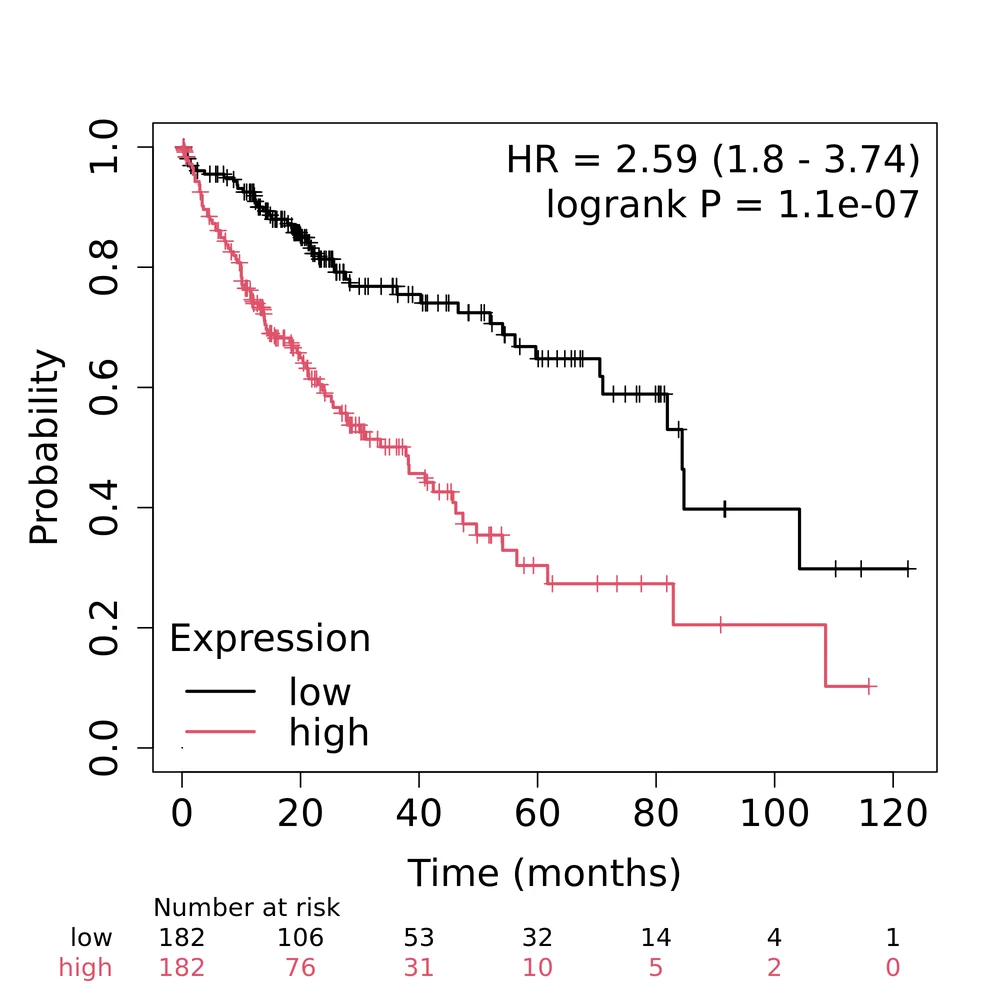
After the disease comparison, literature analysis extracted mTOR-related candidate genes. Gene-expression and survival analyses then evaluated combinations to identify a four-gene candidate signature: PPARGC1A, EIF4E, FKBP1A and RRAGC.

2.59
Discovery HR: high versus low adverse score
95% CI 1.80–3.74

84.4 versus 37.8 months

In the exploratory discovery analysis, median overall survival was 84.4 months for the low adverse-score group and 37.8 months for the high adverse-score group. The analysis included 364 patients, with 182 in each group (log-rank P = 1.1 × 10⁻⁷).

Prognostic association; treatment benefit remains unproven. The signature does not establish why EVOLVE-1 failed or identify patients who will benefit from rapalogs. The discovery analysis used survival outcomes to select the composite. Prospective treatment-specific studies are needed.

Published in Biomedicines (2026). The evidence behind PLA: read the peer-reviewed paper →

Reported mTOR comparison · DDSS 2026

A broader view of mTOR gene evidence.

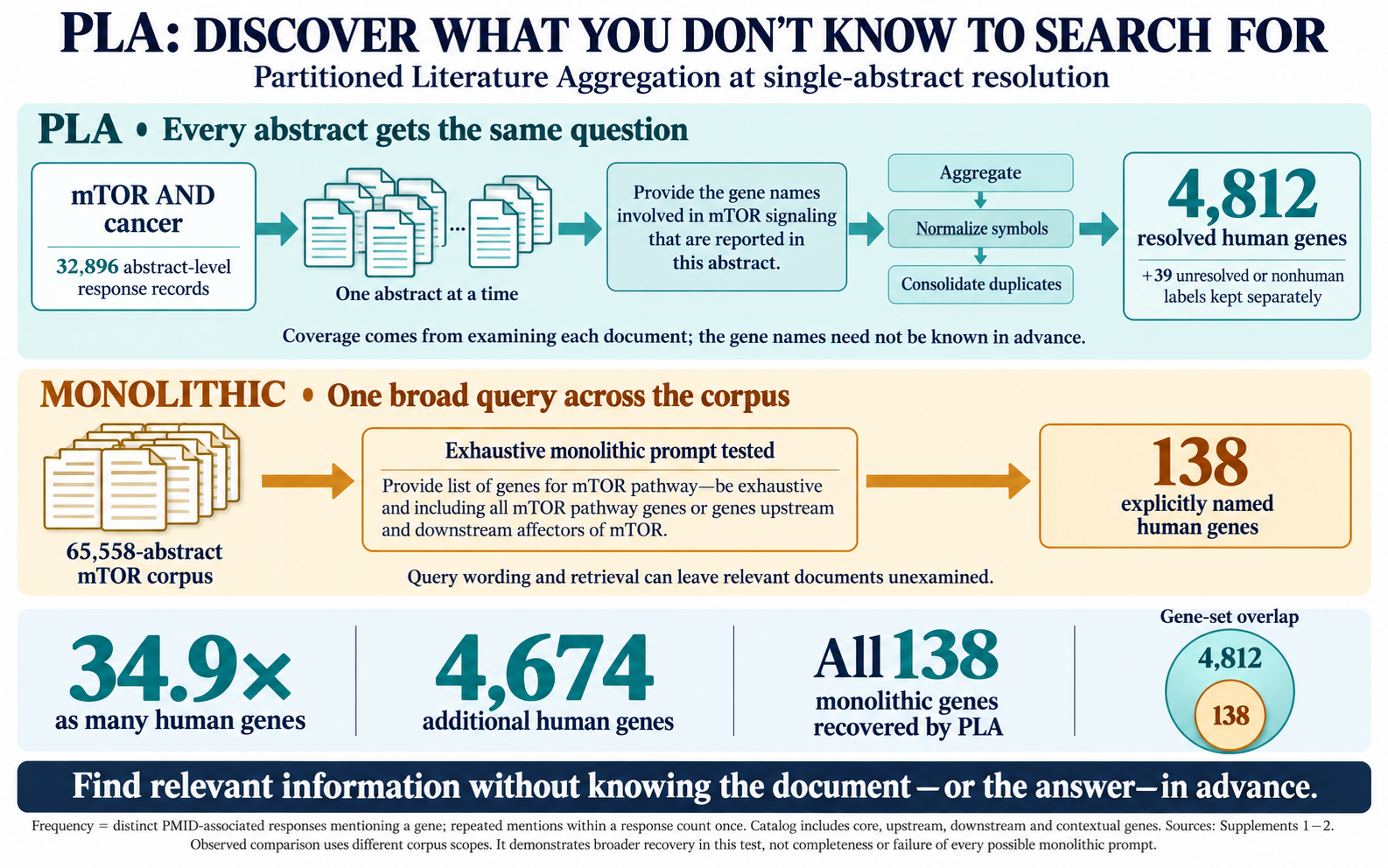
An abstract-by-abstract investigation reported 4,812 resolved human genes, compared with 138 named by one broad query. All 138 broad-query genes were included in the PLA catalog, alongside 4,674 additional genes.

PLA · Individual abstracts

32,896 response records

The mTOR AND cancer example applied the same extraction question to each abstract, then aggregated the answers, normalized gene symbols and consolidated duplicates. The reported output was 4,812 resolved human genes; 39 unresolved or nonhuman labels were kept separately.

Monolithic · One broad query

65,558-abstract corpus

The broad query asked for an exhaustive list of mTOR pathway genes, including upstream and downstream effectors, across an mTOR corpus. It explicitly named 138 human genes.

How to read this example: the corpus scopes and workflows differed. The figures describe gene names recovered in this reported comparison; they are not a controlled performance benchmark or proof of biological importance. This is separate from the HCC study and does not establish a 4,812-gene selection path to its four-gene signature.

Reported PLA gene-discovery comparison: 4,812 resolved human genes versus 138 from a broad query, with all 138 recovered. The original graphic reports different corpus scopes.
Original comparison graphic from the DDSS presentation materials. View the full-size graphic ↗
← Back to how PLA works
Run 01 · YAP1 · June 2026

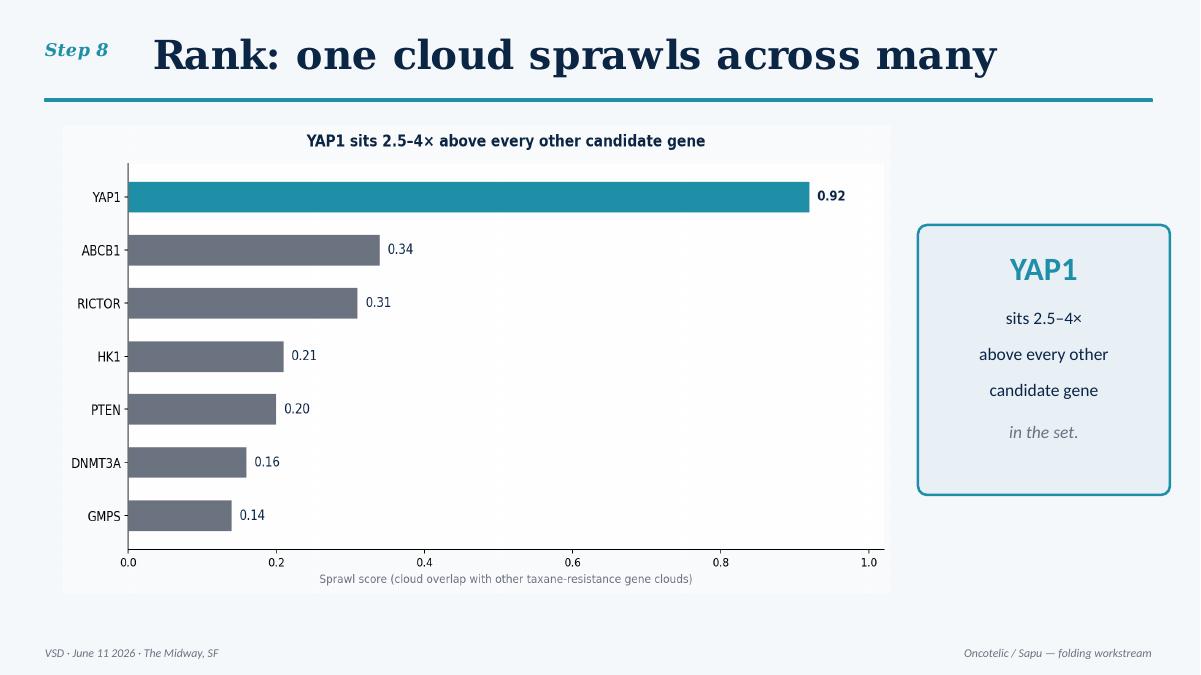
YAP1: a candidate connecting several resistance mechanisms.

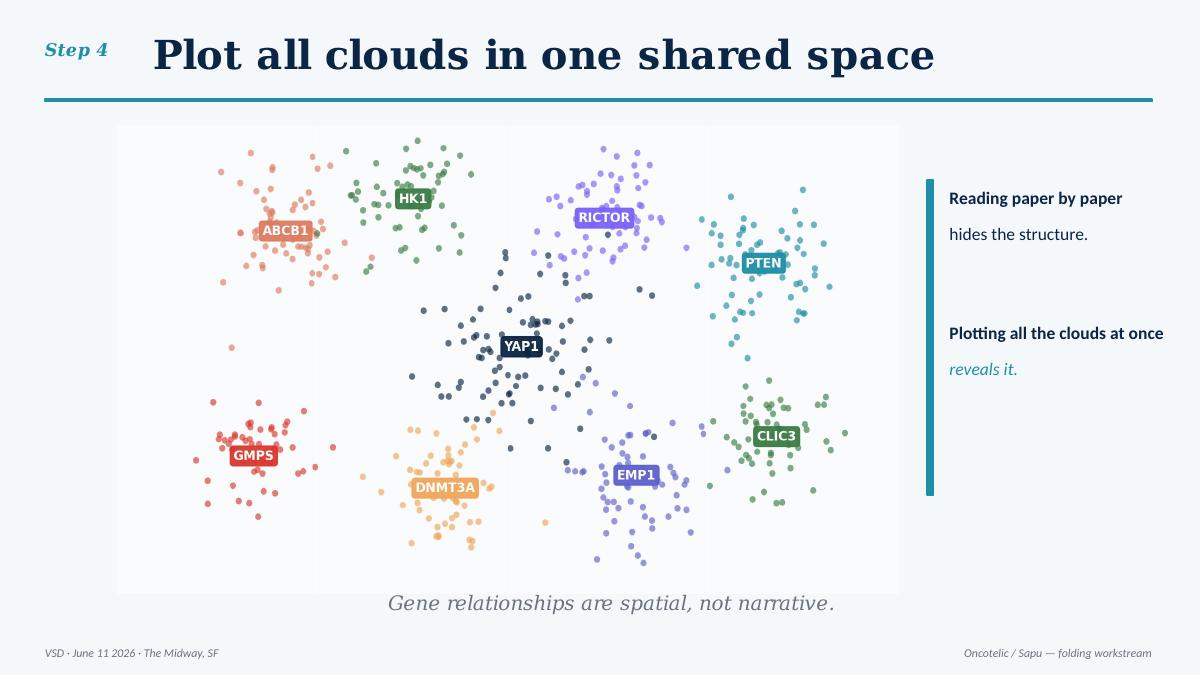
Evidence on taxane resistance is spread across drug efflux, epithelial–mesenchymal transition, mTOR signaling, metabolism and mechanotransduction. The analysis prioritized YAP1 as a candidate connecting these mechanisms.

What the engine measured
Sprawl score 0.92Every candidate scored on how far its literature reaches across independent mechanisms. YAP1 came back at 2.5–4× every other gene in the set.
Five mechanistic domainsDrug efflux, EMT, mTOR signaling, metabolism and mechanotransduction — a footprint no single paper claims together.
How it was checked
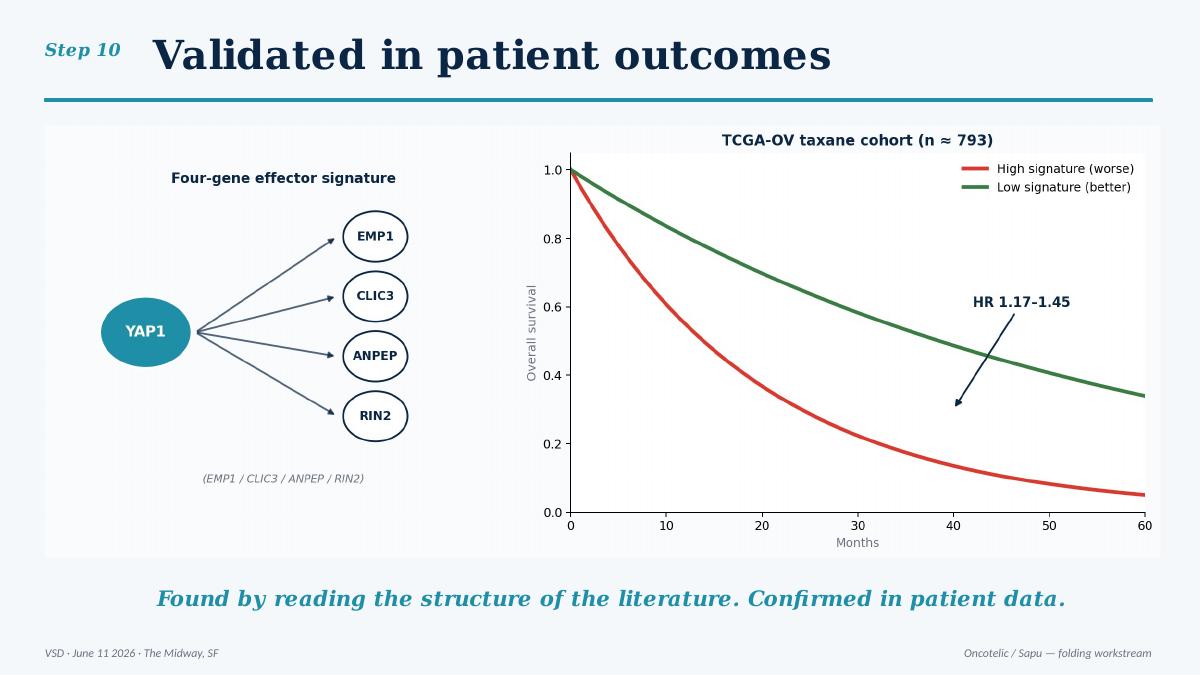
Held out, then testedPatient-outcome data was excluded from the ranking and used afterwards as a check — a four-gene effector panel against public taxane-treated ovarian cohorts, HR 1.17–1.45, univariate and unadjusted.
Filed, then disclosedProvisional filed June 10, 2026. Presented publicly at Vector Space Day on June 11. One day apart, in that order.

This is a hypothesis-generation example. Literature convergence and retrospective survival associations do not establish a causal master regulator or a treatment benefit.

The Method

Partitioned Literature Aggregation.

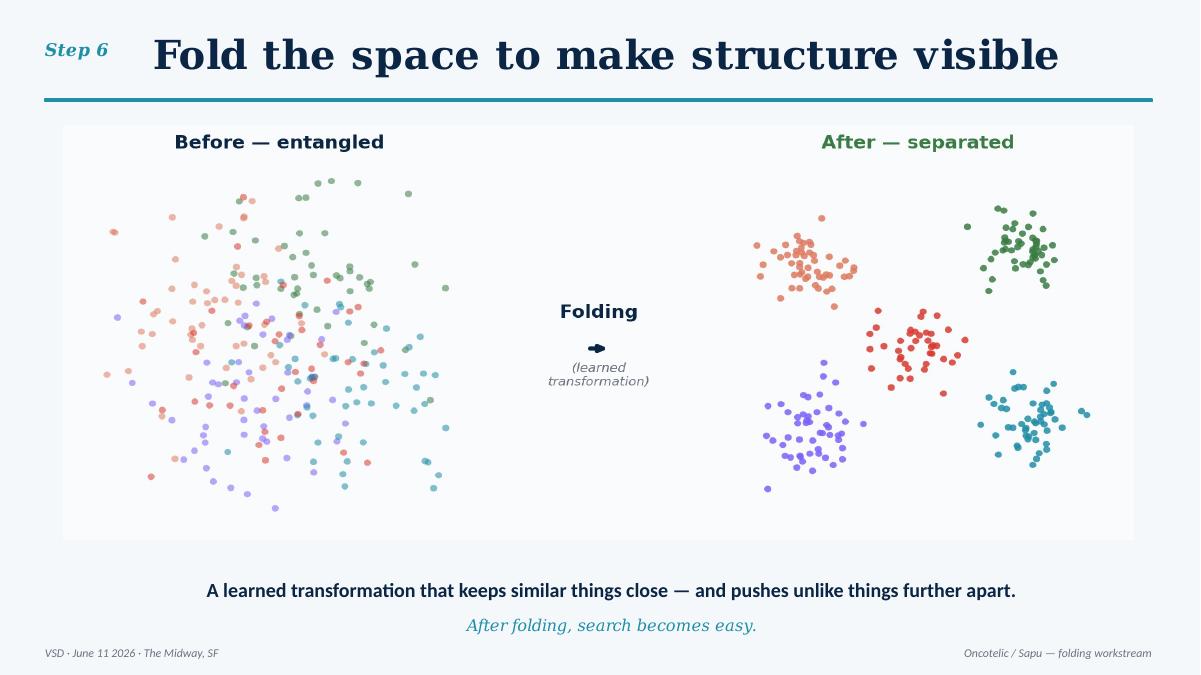
A pooled search can let a large disease literature dominate the available evidence. Partitioned Literature Aggregation organizes focused investigations before combining their findings. A question like what drives resistance to this drug is split into many smaller, biologically meaningful ones — which pathways predict survival, which mechanisms recur across independent datasets — each answered on its own evidence, then recombined into a ranked, weighted conclusion. The partitions come from folding the vector space so related concepts cluster and unlike ones pull apart; evidence for each is drawn from a bounded shell of that partition. Because every conclusion decomposes back into the evidence that produced it, a weak but reproducible signal survives instead of being averaged away by whatever is most cited.

Ingest → Partition → Evidence → Aggregate
01

Ingest

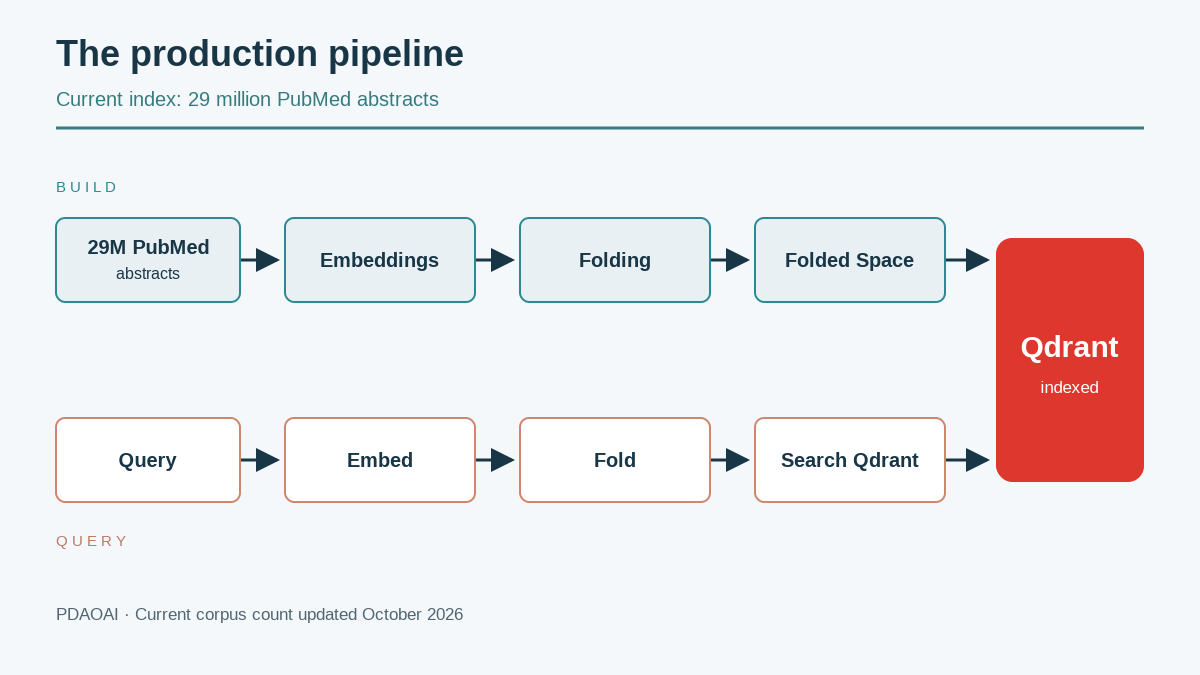
Index ~29M PubMed abstracts — the published biomedical record — plus internal corpora, refreshed on a rolling basis.

02

Partition

Fold the hyperdimensional space so related concepts cluster tightly and unrelated ones pull apart — producing partitions that are biologically meaningful, not merely topically near.

03

Evidence

Sample a bounded shell of each partition independently, clearing the phantom matches that look related but aren't. One question, one body of evidence.

04

Aggregate

Recombine the independent answers into a ranked, evidence-weighted result — the upstream gene, mechanism, or theme everything else moves around.

Search finds the needle. We find the magnet — the thing every needle points to.

From the Vector Space Day 2026 Keynote

The same method, on stage with Qdrant.

Slides from Saran Saund's VSD 2026 keynote in San Francisco, June 11, 2026 — the method above, walked through in front of a technical audience with the numbers attached.

Watch — VSD 2026 Shorts

Three minutes on the folding method.

Highlights from the VSD 2026 keynote posted to the Oncotelic YouTube channel. Vertical shorts optimized for phones — each landing on one core idea in under 60 seconds.

"1 in 10,000"

The attrition problem: 10,000 compounds enter development, one reaches approval. Why target selection is where it's decided.

"Scientists don't Google"

Why keyword search fails for hypothesis generation across the corpus.

"How we built the PubMed index"

The pipeline behind the folding method — from raw abstracts to a searchable folded vector space on Qdrant. Current index: 29 million abstracts. Archival VSD 2026 recording; figures shown in the footage reflect the corpus at that time.

Watch the full 20-minute VSD 2026 keynote — "Building the DNA of Search" with Bastian Hofmann (Qdrant), Saran Saund and Scott Myers (Oncotelic) — watch it on YouTube →

Peer-Reviewed Record

The engine, in the literature.

The method is documented in peer-reviewed publications, with the working stack disclosed in Methods — embedding, clustering and vector-database components named by version. In these papers the platform appears as “Oncotelic Chatbot technologies”, the name it carried at the time of writing.

Biomedicines · 2026 · Latest publication

Partitioned Literature Aggregation and Transcriptomic Survival Analysis Identify an Immune-Contextualized Four-Gene mTOR Prognostic Composite in Hepatocellular Carcinoma

Published October 23, 2026 · 14(11):2438 · Open access

Read the full paper ↗
Cancers · 2025

Positive Prognostic Overall Survival Impacts of Methylated TGFB2 and MGMT in Adult Glioblastoma Patients

Qazi S, Potts M, Myers S, Richardson S, Trieu V.
Cancers. 2025;17(7):1122

Engine in Methods §2.1 — AI-augmented literature analysis

doi:10.3390/cancers17071122 →

Int J Mol Sci · 2025

Comparative Tumor Microenvironment Analysis for HCC and PDAC Using KMplotter

Chang W-H, Shah D, Myers S, Potts M, Qazi S, Trieu V.
Int J Mol Sci. 2025;26(24):11920

Engine in Methods §4.1 — 32,264 abstracts processed

doi:10.3390/ijms262411920 →

Applied Work · Int J Mol Sci · 2025

Bioinformatic Approach to Identify Potential TGFB2-Dependent and Independent Prognostic Biomarkers for Ovarian Cancers Treated with Taxol

Qazi S, Richardson S, Potts M, Myers S, Saund S, De T, Trieu V.
Int J Mol Sci. 2025;26(24):11900

Conventional bioinformatics — this paper does not describe the engine. Included for the biology, which sits in the same taxane-treated setting as the case study above.

doi:10.3390/ijms262411900 →

All open access.